FW v2.0.3: A Bigger Buffer Goes Stable and Digital Inputs Get Downlink Config
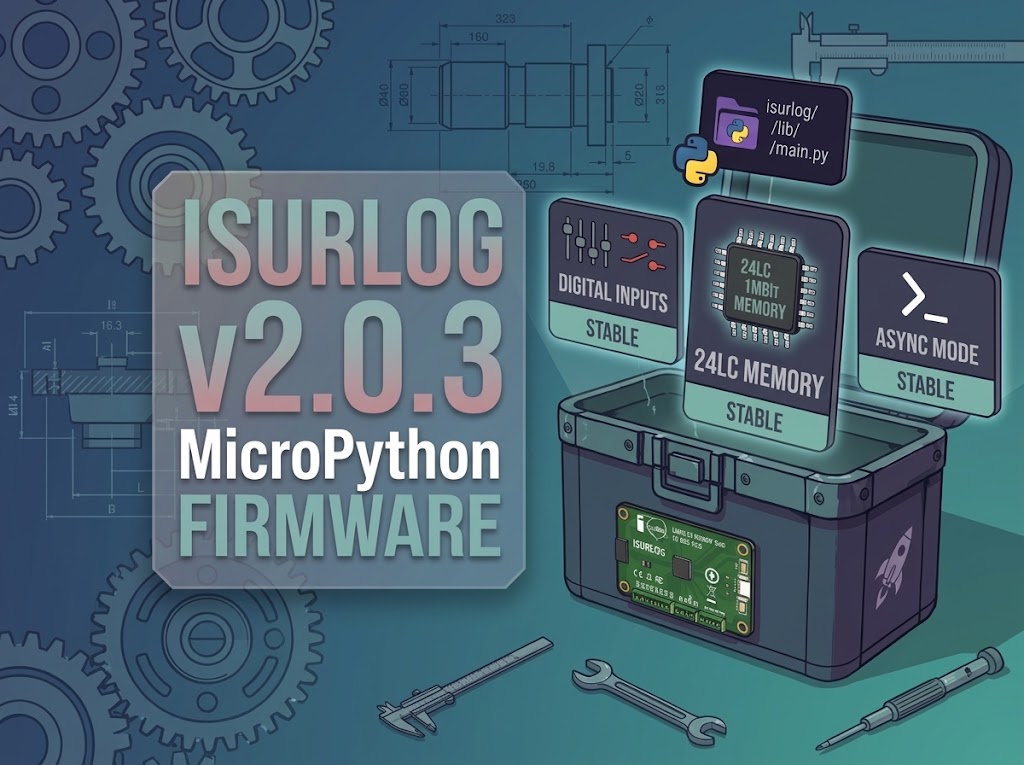
Firmware v2.0.3 is out. Two features that have been running in the field under an "Experimental" label graduate to Stable in this release, and digital inputs (GP3/GP4/GP5 on the MCP23008 expander) can now be configured remotely instead of only from a fresh flash.
What's new
The EEPROM transmission buffer is now Stable
Since FW v2.0.2, ISURLOG has been able to spill its transmission queue onto the external 24LC1025 I2C EEPROM once RTC RAM's hard ~2KB limit is reached — instead of losing readings during a connectivity outage that outlasts a handful of cycles. That mechanism has now run enough real cycles to drop the "Experimental" label.
One consequence worth knowing about even if you never touch the setting: the Record accumulator parameter (how many readings get batched before a transmission) can now go all the way up to 1023 — up from 255. That number isn't arbitrary: it's exactly how many payload slots fit in the 24LC1025's 128 KB at the default 128-byte payload size. Set it any higher and you'd be asking for more buffer than the chip physically has.
Async function architecture is now Stable
The asynchronous task architecture introduced in FW v2.0.1 — parallelizing sensor reads, network connection, and transmission instead of running them strictly in series — also graduates to Stable in this release. Less time with the radio and the sensor supply rails powered means less battery spent per cycle.
Digital inputs (GP3/GP4/GP5) are now configurable via downlink
The MCP23008-based digital inputs — channels 1/2/3, alongside the native ULP-counted channel 0 — could only be set up at flash time until now. setDigitalEnable, setDigitalWake, setDigitalLow/setDigitalHigh and the rest of that command family now correctly target the right channel in digital_config.inputs[] instead of silently landing on the old flat, single-channel schema. If you're scripting configuration through the downlink API rather than IsurDASH's UI, this is the piece that made per-channel digital input config actually reach the device.
Bug fixes worth knowing about
MQTT keep-alive could exceed the protocol's own limit
keep_alive is derived from latency_time × register_acumulator — and MQTT's Keep Alive field is a 16-bit value, hard-capped at 65535 seconds. With the accumulator's new 1023 ceiling (see above), that overflow became easy to hit with an otherwise reasonable configuration, not just an edge case. main.py now clamps keep_alive to that limit and logs a warning if your configured latency/accumulator combination would have exceeded it, instead of handing the modem or umqttsimple a value it was never built to carry.
MCP23008 digital inputs (GP3/GP4/GP5) could read stale polarity after certain wake paths
input_polarity and interrupt_enable on the MCP23008 expander were only guaranteed to reset when theft_alert was enabled — leaving GP3/GP4/GP5 dependent on whatever state the chip happened to be carrying over otherwise. configure_input() now forces both explicitly on every boot, regardless of the theft-alert setting.
Upgrading
Update from 6.8. Device Maintenance in IsurDASH — over the air on FW v1.1.9+, or over USB for anything older — and pick the release marked Latest, not a pre-release. Manual flashing instructions are in Flashing and Application Upload if you're not going through IsurDASH.
Full change history: GitHub Releases.