3. Communications
The ISURLOG includes integrated Wi-Fi and Bluetooth capabilities. Additionally, it can contain either a LoRa or an NB-IoT communication module, as these two options are mutually exclusive.
3.1. LoRaWAN
The ISURLOG utilizes LoRaWAN technology (derived from LoRa, Long Range modulation) for long-range wireless data transmission. It operates in the license-free 868 MHz frequency band, which is standard for Europe.
Note
868 MHz is the only factory configuration available. If you require a different regional frequency, please contact ISURKI directly.
Connection Requirements and Safety
It is imperative that the antenna is always connected before powering on the device to avoid permanent damage to the radio frequency circuit.
- The antenna used must be designed for 868 MHz.
- It must have an impedance of 50 Ohms and a low VSWR to ensure maximum efficiency.
- The ISURLOG board is equipped with a U.FL type antenna connector.
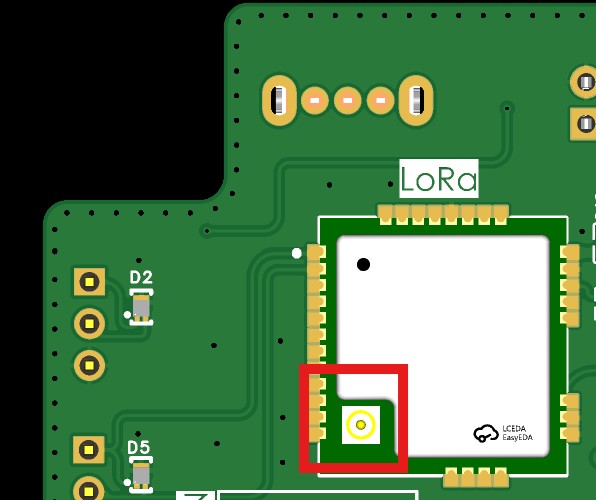
The U.FL antenna connector, LoRaWAN module.
3.2. NB-IoT (Narrowband IoT)
NB-IoT is a wireless communication technology specifically designed for the Internet of Things (IoT). Its narrow band approach enables efficient connectivity in urban and suburban environments, excelling in penetration into hard-to-reach areas.
Energy Efficiency and Bi-Directional Communication
While NB-IoT offers lower data speeds compared to broadband technologies, it is ideal for IoT applications that do not require real-time transmission, focusing on energy efficiency and prolonging battery life.
Thanks to the combination of NB-IoT and the eDRX (extended Discontinuous Reception) power-saving mode, the NB version of the ISURLOG offers bi-directional communication. This key feature allows the user to remotely "wake up" the datalogger at any time to force a reading or change parameters, an operation managed from the IsurDASH cloud platform.
Connection Requirements and Safety
It is imperative to connect an LTE antenna to avoid damaging the radio frequency circuit.
- The connector for the LTE antenna provided on the ISURLOG is of the U.FL type.
- Thanks to its advanced RF front-end architecture, this same connector and antenna also serve GPS reception — a single antenna is enough for both, no separate GPS antenna or connector is needed.
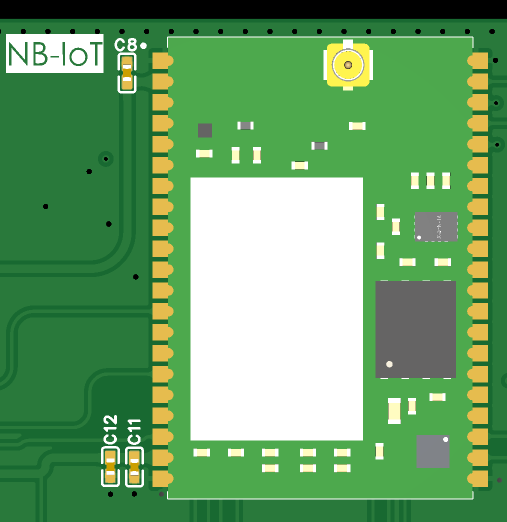
The U.FL antenna connector, NB-IoT module — shared with GPS, no separate antenna needed.
SIM Management Flexibility
The ISURLOG offers two flexible options for managing the NB-IoT subscription:
- Integrated eSIM: The device features an embedded SIM (eSIM) soldered onto the board. This eSIM can be used with a data plan provided by ISURKI (consult terms and conditions).
- External Nano-SIM: Users have the option to utilize their own physical Nano-SIM card by inserting it into the corresponding slot on the ISURLOG. This SIM must have an NB-IoT compatible data plan contracted with the user's preferred operator.
3.3. Wi-Fi & BLE
Unlike LoRaWAN and NB-IoT, which are external radio modules and mutually exclusive with each other, Wi-Fi and Bluetooth Low Energy (BLE) are built into the ESP32 chip itself — they are present on every ISURLOG regardless of which external communication module (if any) is fitted.
- Wi-Fi: 802.11 b/g/n, 2.4 GHz. Can be used as an alternative way to upload data to the platform.
- Bluetooth: v4.2 (BR/EDR + BLE). Used for the local, real-time connection described in 1.8 Internal Sensors and Diagnostics (device configuration and live sensor viewing over Bluetooth) — available regardless of which external communication module is installed.
Both radios use the antenna integrated directly on the PCB — no external antenna or connector is required for Wi-Fi or Bluetooth.