1. Consumption Graphs
Real current-vs-time captures showing what each part of the duty cycle actually costs — a companion to the Power Budget & Battery Life Calculator, grounded in measurement instead of estimates. This page grows over time as new captures become available.
1.1 Measurement Method
Equipment. ISURLOG's current draw spans a very wide range — roughly 20µA in deep sleep up to 0.5A+ during a transmit burst — so a regular multimeter can't track both ends of that swing accurately. A meter with autoranging is required. Captures on this page use the Nordic Power Profiler Kit II (PPK2), with its Power Profiler app for nRF Connect for Desktop, but any autoranging current meter is valid — the choice is left to the reader.
Wiring — the I_SENSE jumper. All battery current passes through the I_SENSE jumper (see 2.2. Jumper Configuration for Power Modes). In normal operation it stays closed (shorted). To measure consumption:
- Open/remove the I_SENSE jumper.
- Insert the meter in series: the inner pin (pin 1 below) is VIN (battery side) — connect it to the meter's VIN. The outer pin (pin 2) connects to the meter's VOUT.
- Tie the meter's GND to an ISURLOG GND — e.g. at the ESP32 or RAK3172 UART header pins.
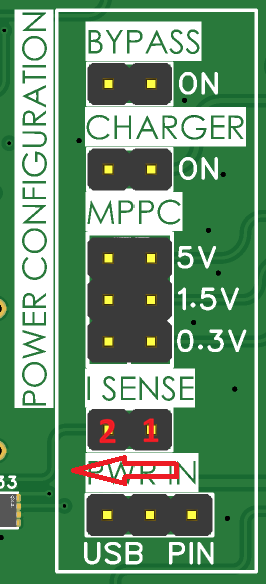
Wiring the PPK2 in series across the I_SENSE jumper.
Conditions. Each capture below notes the firmware version, connectivity, and sensor configuration it was taken under — real numbers vary with these, so treat them as a reference point, not a spec sheet.
General
Right after power is disconnected and reconnected, the board can draw around 23 µA above the specified minimums for the first few minutes. This is caused by the MAX17048 fuel gauge still running its initialization calculations and calibration — not a fault, and not representative of steady-state consumption. Captures on this page are taken well past this initial window.
1.2 Captures
Deep Sleep — NB-IoT/LTE-M
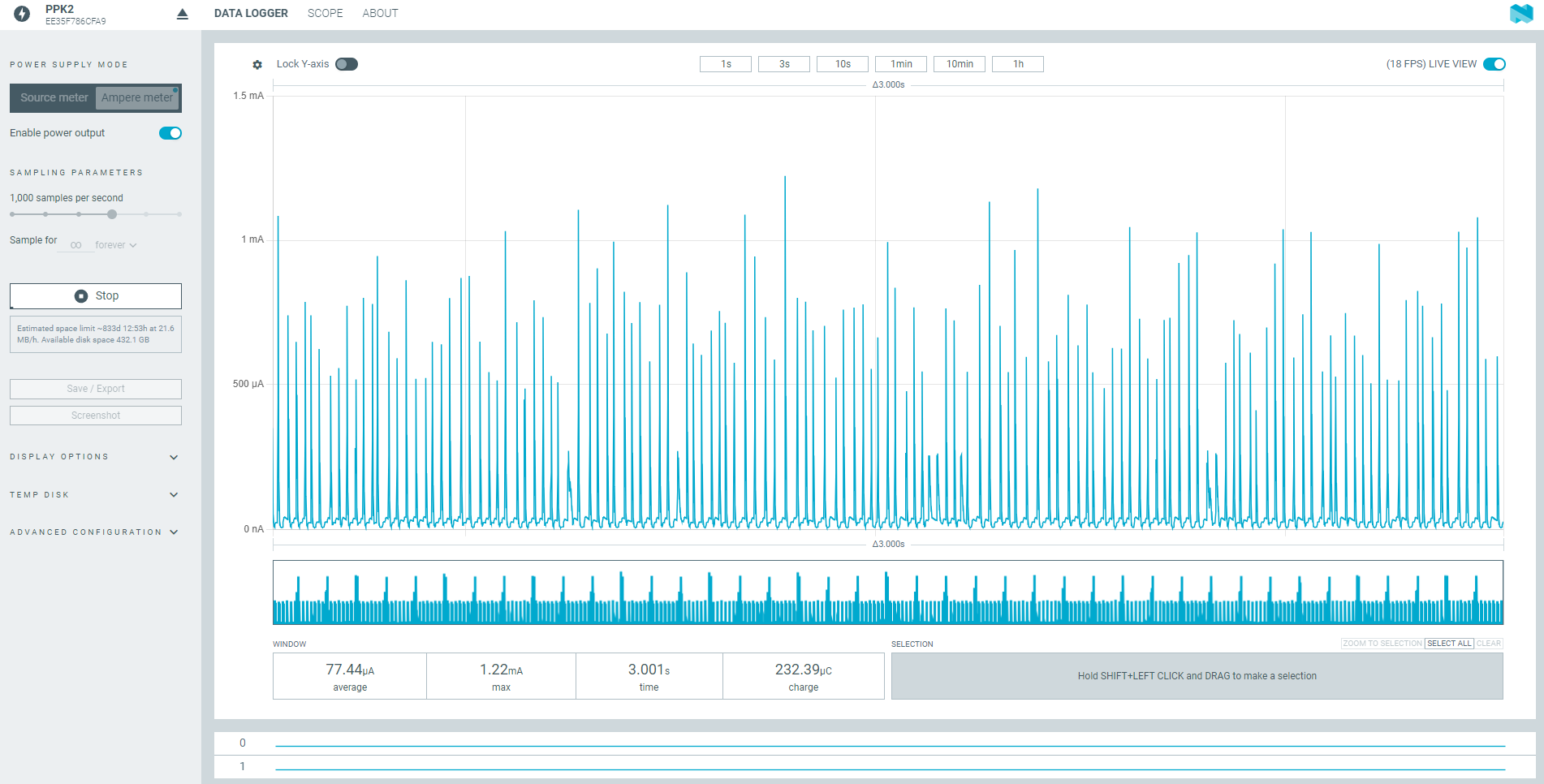
Deep sleep current draw, NB-IoT, 3-second window.
Captured with the PPK2 in Ampere meter mode, 1,000 samples/second, over a 3-second window:
- Average: 77.44 µA
- Peak: 1.22 mA (periodic short spikes visible in the trace)
- Window: 3.001 s · Charge: 232.39 µC
What this figure includes
This is the full system at rest, not the ESP32 alone: ESP32 deep sleep plus the nRF9151 modem, powered on and already attached to the NB-IoT network — no reconnect/re-attach pending when the next scheduled transmission comes due. That's why it reads higher than a bare-ESP32 deep sleep figure; it's the more realistic number for a deployed unit.
The periodic spikes
The regular short spikes riding on top of the baseline come from the board's own power regulator: at very light load (like deep sleep), it switches to a pulsed low-power operating mode — firing brief current pulses to top up its output capacitor instead of switching continuously. The downstream draw itself stays smooth; the pulses are the regulator's own behavior, not the ESP32 or modem doing anything.
Longer window — eDRX paging cycle:
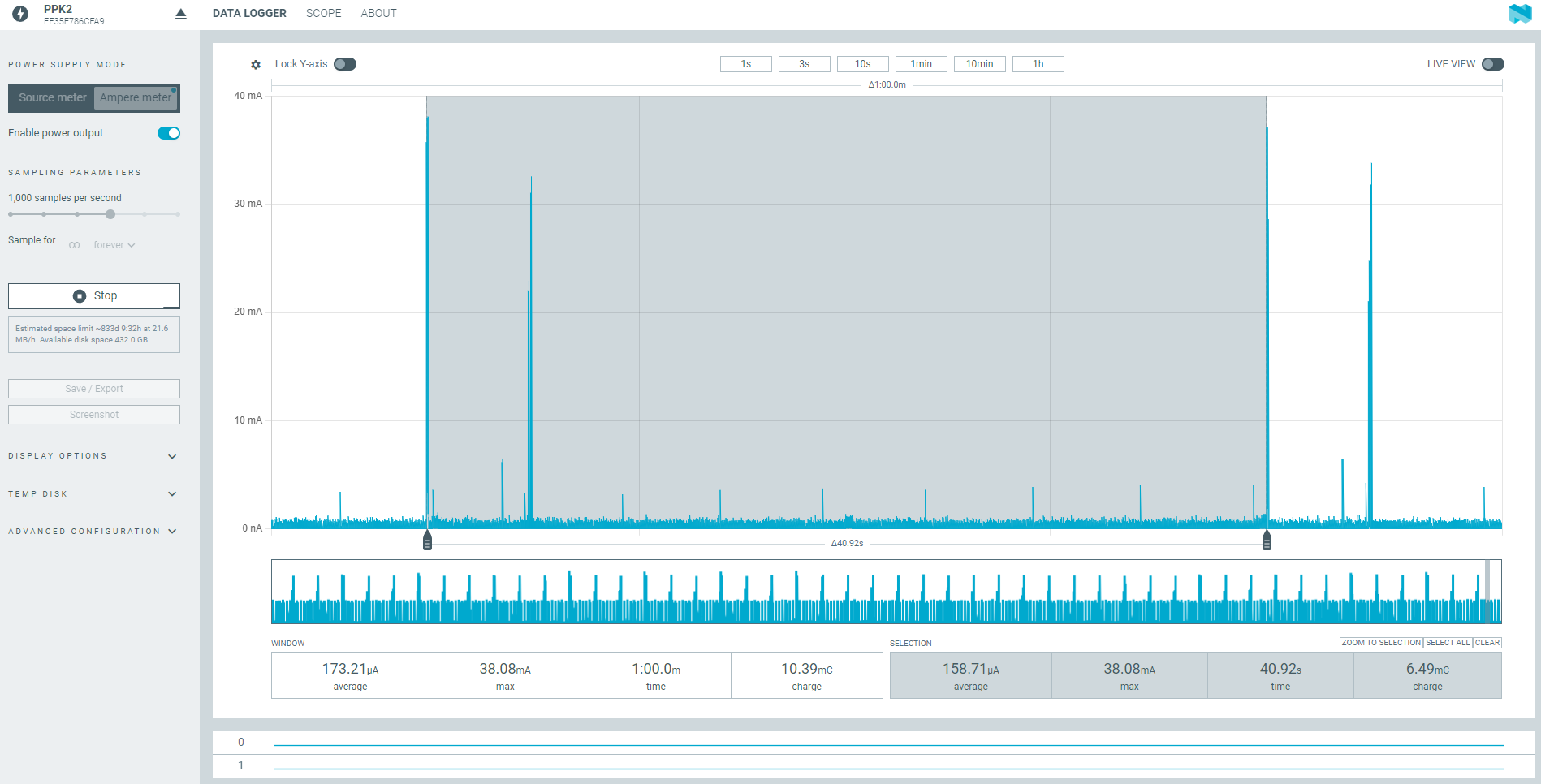
The same deep sleep state, zoomed out to a 1-minute window — eDRX paging spikes visible.
Zooming out to a 1-minute window reveals a second, larger periodic spike (30-38 mA) on top of the baseline — these are the modem's eDRX paging occasions, where it briefly wakes to listen for the network. The interval between two consecutive occasions is 40.96 s on standard firmware, matching the 40.92 s measured here.
- Window average: 173.21 µA · Window max: 38.08 mA · Window charge: 10.39 mC (1 minute)
- Between two paging occasions: 158.71 µA average · 40.92 s · 6.49 mC charge
Deep Sleep — LoRaWAN
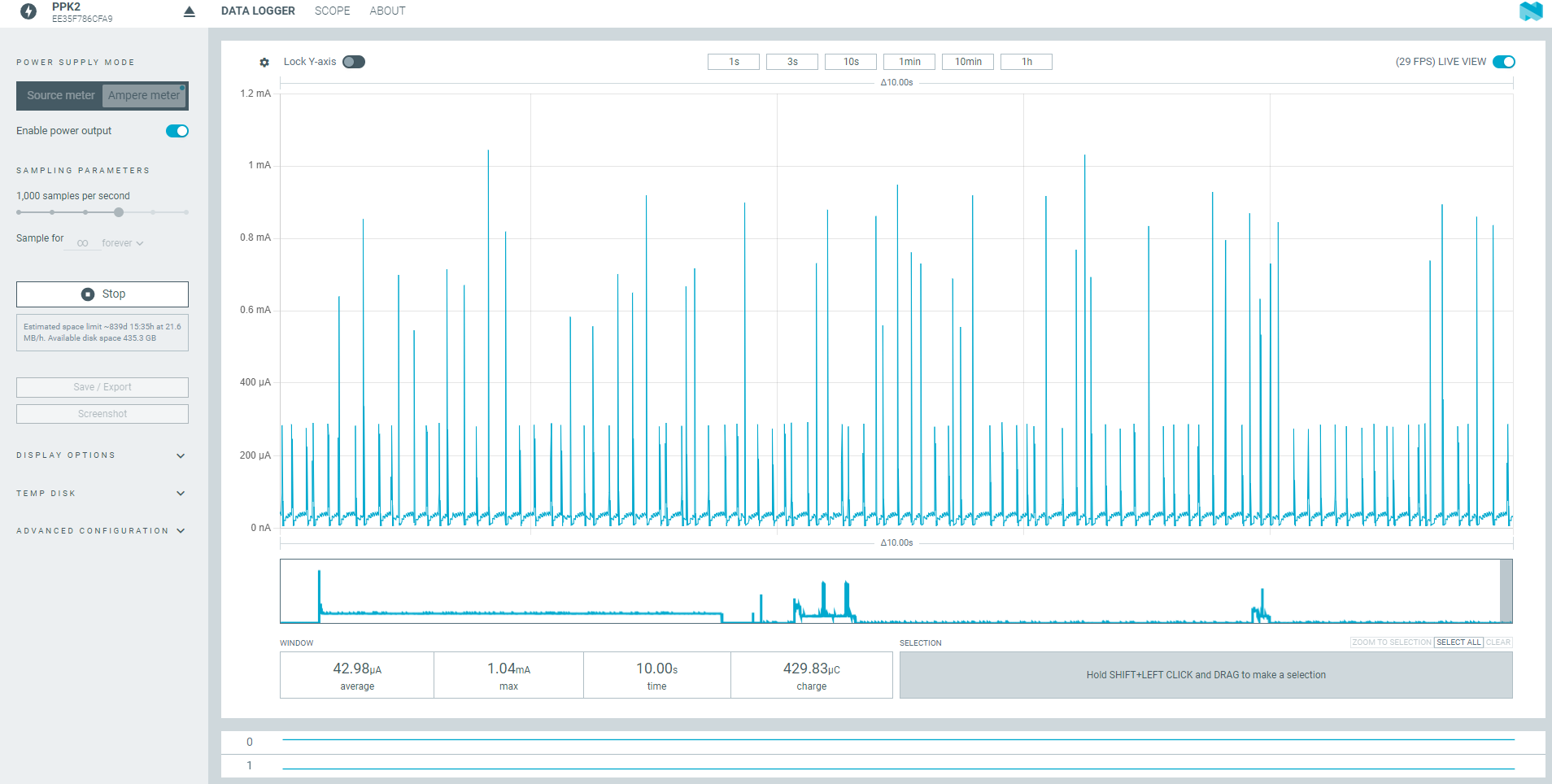
Deep sleep current draw, LoRaWAN, 10-second window.
Captured with the PPK2 in Ampere meter mode, 1,000 samples/second, over a 10-second window:
- Average: 42.98 µA
- Peak: 1.04 mA (periodic short spikes visible in the trace)
- Window: 10.00 s · Charge: 429.83 µC
What this figure includes
This is the full system at rest, not the ESP32 alone: ESP32 deep sleep plus the RAK3172 modem, powered on and already joined to the LoRaWAN network, in its own low-power sleep mode. Lower than the NB-IoT figure above — expected, since LoRaWAN's idle power draw is inherently lower than a cellular modem's.
The periodic spikes
Same cause as the NB-IoT capture above: the board's own power regulator switching into a pulsed low-power operating mode at very light load, firing brief current pulses to top up its output capacitor. Not the ESP32 or modem doing anything.
🚧 Coming soon
Deep Sleep — Wi-Fi, Wake + Sensor Read, and a transmission-cycle capture for each connectivity option.